Most Brands Don’t Have a Marketing Problem. They Have an Attention Problem.
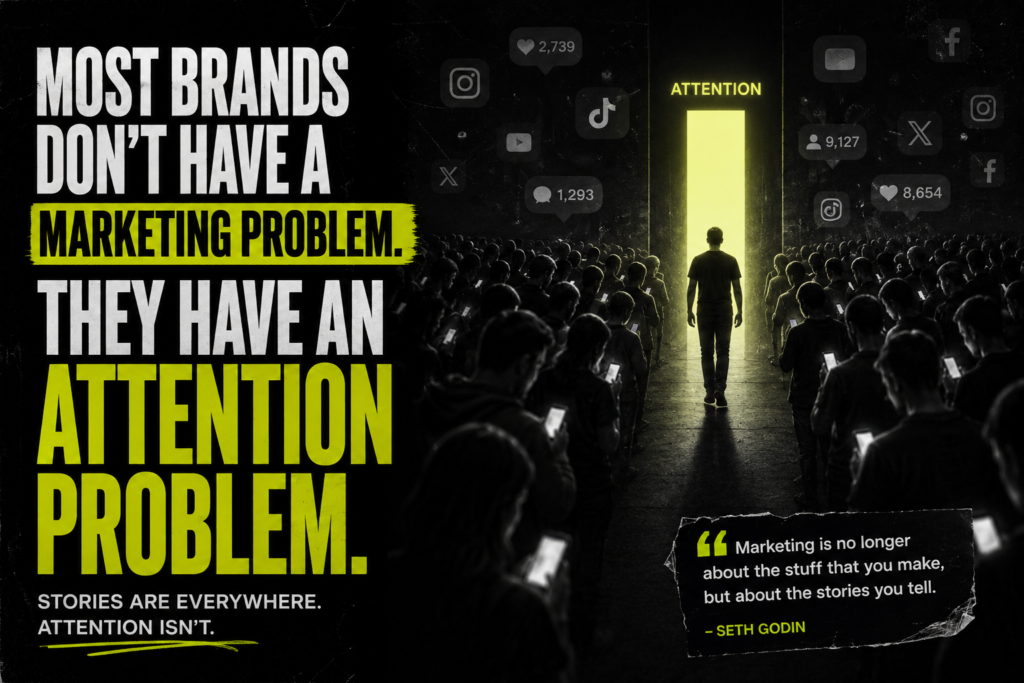
“Marketing is no longer about the stuff that you make, but about the stories you tell.” — Seth Godin
Most brands heard this quote.
Very few actually understood it.
Because the internet evolved.
Storytelling alone is no longer enough.
The modern internet is flooded with stories, content, ads, podcasts, carousels, threads, founder posts, short form videos, “personal brands,” and algorithmically optimized noise competing for the same exhausted human attention.
The real problem now is not content production.
It’s attention scarcity.
The internet became too loud
Everyone is posting constantly.
Everyone is optimizing hooks.
Everyone is building funnels.
Everyone is “creating value.”
Everyone is chasing engagement.
And most of it feels completely forgettable.
Because modern marketing became obsessed with distribution mechanics while ignoring the thing that matters first:
Whether anybody actually stops scrolling.
That’s the entire game now.
Before:
- Clicks
- Conversions
- Subscribers
- Customers
- Referrals
- Revenue
…comes attention.
Your startup may solve a real problem.
Your product may genuinely help people.
Your campaign may be strategically brilliant.
But if nobody notices it, none of it matters.
The market is not starving for products.
It’s starving for things worth noticing.
Most advertising now feels algorithmically generated
Scroll LinkedIn for 60 seconds.
You’ll see:
- Identical hooks
- Identical “storytelling”
- Identical founder wisdom
- Identical AI-generated thought leadership
- Identical fake vulnerability posts
- Identical growth frameworks
- Identical beige corporate carousels
Everything blends together.
The same thing happened to advertising.
Every ad now looks like:
- Over-optimized UGC
- Fake podcast clips
- Forced storytelling formulas
- Subtitles engineered for retention
- Recycled emotional manipulation
Brands optimized themselves into invisibility.
And ironically, that creates massive opportunity.
Because when everything looks the same, distinctiveness becomes extremely valuable.
Attention is emotional before it is rational
Most marketers still think attention is logical.
It’s not.
People stop because something creates:
- Curiosity
- Tension
- Surprise
- Humor
- Aspiration
- Disagreement
- Confusion
- Identity signaling
Attention is emotional physics.
That’s why weird brands often outperform polished ones.
The weird brand interrupts the feed.
The polished brand becomes wallpaper.
This is also why internet-native brands continue outperforming traditional corporate marketing.
They understand:
- Timing
- Internet culture
- Aesthetics
- Humor
- Screenshots
- Memes
- Language
- Emotional resonance
Modern attention is deeply social.
People no longer consume content passively.
They use content to communicate identity to other people.
That changes everything.
The strongest brands create reactions, not just campaigns
Traditional marketing still revolves around campaigns.
Launch.
Promote.
Measure.
Repeat.
But the strongest internet brands behave differently.
They create things people:
- Screenshot
- Send to friends
- Repost
- Argue about
- Laugh at
- Reference later
- Remember weeks later
That’s attention leverage.
And attention leverage compounds much harder than paid impressions.
A paid ad may buy temporary visibility.
A culturally relevant idea creates momentum.
Momentum spreads itself.
Safe brands disappear
One of the biggest reasons most companies become forgettable is because they’re terrified of being disliked.
So they smooth every edge off their positioning.
The result?
Nothing emotionally lands.
Safe brands disappear into the feed.
Distinct brands become reference points.
That doesn’t mean brands should become intentionally obnoxious.
But it does mean they need:
- Perspective
- Personality
- Conviction
- Taste
- Energy
The brands people remember usually feel human.
Human beings are not perfectly optimized.
They have opinions.
Humor.
Imperfections.
Contradictions.
That’s what creates memorability.
Why homepage placements and backlinks still matter
This is also why homepage features and editorial placements are quietly becoming valuable again.
Not because homepage traffic magically solves marketing.
But because placement creates context.
A homepage feature says:
“This deserves attention.”
That signal matters psychologically.
Especially now.
We live in an internet environment drowning in disposable content and collapsing trust.
A homepage placement cuts through that noise.
And unlike social posts that disappear within hours, homepage placements and archive pages create:
- Backlinks
- Searchable permanence
- Discoverability
- Referral traffic
- Indexed authority
- Digital infrastructure
That’s a massive difference.
Most brands are renting attention.
Very few are building infrastructure.
Infrastructure compounds.
Algorithms trained brands to chase short term dopamine
Modern platforms reward endless activity.
Post more.
Trend faster.
Publish daily.
Stay visible.
Feed the machine.
The result?
Most brands became trapped inside endless content production cycles that generate almost no long-term value.
Everything became disposable.
A Reel disappears.
A TikTok dies.
A tweet gets buried.
An ad campaign ends.
But permanent internet assets continue working:
- Strong websites
- Homepage features
- Backlinks
- Archives
- Searchable content
- Owned audiences
That’s why smart operators are shifting back toward infrastructure.
Because rented attention becomes more fragile every year.
The future belongs to brands with gravity
Most brands are producing content.
Very few are producing gravity.
Gravity pulls people in naturally.
Gravity creates:
- Curiosity
- Anticipation
- Memorability
- Conversations
- Screenshots
- Referrals
- Emotional connection
You cannot brute force gravity forever with media spend.
Eventually the market decides whether your brand is genuinely interesting.
Interesting brands have unfair advantages.
People voluntarily market them.
That’s the dream.
Not forcing attention.
Earning it.
Final thought
Most brands are fighting for impressions.
The smartest brands are fighting for memory.
Because memory creates:
- Direct traffic
- Brand recall
- Word of mouth
- Screenshots
- Conversations
- Loyalty
- Pricing power
- Cultural relevance
In a world flooded with infinite content, memorability becomes one of the most valuable assets on the internet.
That’s why attention matters more than ever.
Not shallow attention.
Not vanity metrics.
Not accidental clicks.
Real attention.
The kind that makes people stop.
Look twice.
Send it to someone.
Talk about it later.
Remember your name.
That’s the real game now.
And the brands capable of earning that kind of attention will quietly dominate the next era of the internet.